
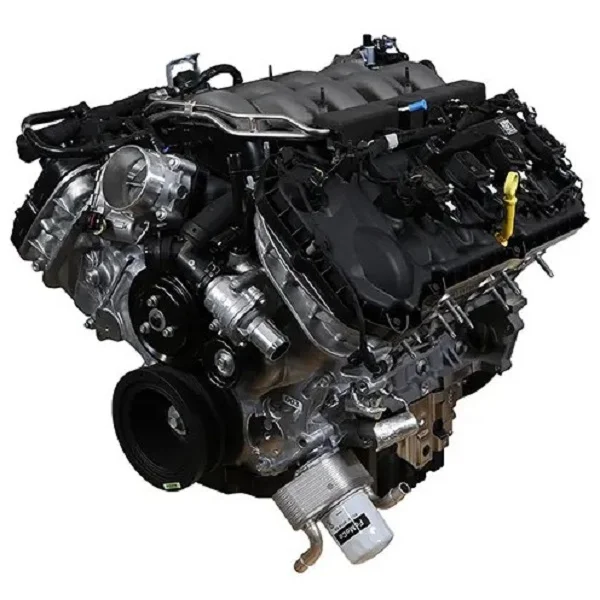
Gen 3 Coyote Engine for Sale | Ford 5.0L V8 DOHC (302 cu in)
$5,999.00
Product Overview & Specifications
- In Stock, Multiple Year Ranges Available 2018 to 2023
- Free Shipping to All 50 States via Crated Freight, 5 to 10 Business Days
- All 8 Cylinders Compression Tested, Results Available Before You Pay
- Year and ECU Calibration Documented Before Shipping
- Both Fuel Systems Inspected (High-Pressure Pump and Port Injectors)
- Ti-VCT Operation Verified
- Timing Chain Stretch Inspected
- 100% Fitment Verified Before Every Order Ships
- No Core Charge, Keep Your Old Engine
- 15 Day Replacement Warranty on Internal Defects
 100% Fitment Assistance
 15 Days Replacement Warranty
 Free & Fast Shipping
About This Engine
The Gen 3 Coyote is the third generation of Ford’s modern 5.0 liter Coyote V8, introduced for the 2018 model year and produced through 2023. It powers the 2018 to 2023 Mustang GT, the 2018 to 2020 F-150 (5.0 trim), the limited-production 2019 Mustang Bullitt, and a small handful of specialty applications. Compared to the Gen 2 Coyote it replaced, the Gen 3 brings substantial engineering changes: a dual fuel injection system that combines high-pressure direct injection with low-pressure port fuel injection, a higher 12.0:1 compression ratio, redesigned high-flow cylinder heads, and a Plasma Transfer Wire Arc bore coating that replaces traditional iron cylinder liners with a thin sprayed steel layer.
The result is a naturally aspirated 5.0L V8 that produces 460 horsepower at 7,500 rpm and 420 lb-ft of torque at 4,600 rpm, all on premium unleaded pump gas. The Mustang GT version is rated to spin to an 8,250 rpm fuel cut, with a true power peak at 7,500 rpm. For drivers stepping up from a Gen 1 or Gen 2 Coyote, the Gen 3 immediately stands out for its broader torque curve, more aggressive throttle response, and willingness to rev hard well past where earlier Coyotes lost their breath.
Why Owners Choose a Used Gen 3 Coyote
Used Gen 3 cores are abundant relative to demand because Ford built hundreds of thousands of them across Mustang GT and F-150 production. A clean tested unit costs roughly half of a new Ford Performance crate motor while delivering essentially the same hardware. For Mustang owners replacing a worn unit, F-150 owners doing an engine replacement, or builders doing a Coyote swap into an older Mustang, hot rod, or kit car chassis, a verified used Gen 3 is the smart choice.
Signs You Need a Replacement Gen 3 Coyote
- Knock or rattle under load, rod or main bearing wear (rare on this generation but possible past 100,000 miles)
- Loss of power and direct injection codes, high-pressure fuel pump wear
- Misfire codes that follow specific cylinders, ignition coil or fuel injector issue
- Excessive oil consumption, ring or PCV system wear
- Coolant in oil or oil in coolant, head gasket failure (typically post-overheat event)
- Timing chain rattle on cold start, timing chain stretch
- Cam phaser noise on startup, Ti-VCT phaser wear (better controlled on Gen 3 than Gen 1)
Known Gen 3 Coyote Issues We Inspect Before Shipping
- High-pressure fuel pump operation, critical for the dual-fuel system
- Both port and direct injectors tested for proper spray pattern
- Timing chain stretch inspected, with replacement recommendation if past service
- Cam phaser operation tested on both banks
- Compression on all 8 cylinders, the leading indicator of overall condition
- Bore coating integrity checked at the head deck (no scoring)
- Year, ECU calibration, and donor application photographed
- Donor mileage documented when available
| engine-family | Ford Modular Coyote V8 Gen 3 |
|---|---|
| configuration | 32 valves, V8 DOHC |
| displacement | 5.0L (302 cu in) |
| bore-x-stroke | 93.0 mm x 92.7 mm |
| compression-ratio | 12.0:1 |
| aspiration | Naturally Aspirated |
| fuel-system | Dual injection (port plus direct) |
| fuel-type | Premium Unleaded |
| valve-train | DOHC with Ti-VCT |
| block-material | Aluminum with PTWA bore coating |
| head-material | Aluminum |
| connecting-rods | Forged steel |
| pistons | Forged aluminum with cooling jets |
| firing-order | 1-3-7-2-6-5-4-8 |
| production-years | 2018 to 2023 |
| horsepower | 460 hp at 7, 500 rpm (Mustang GT) |
| torque | 420 lb-ft at 4, 600 rpm |
| rev-limit | 500 rpm, 7 |
| engine-weight | Approximately 445 lbs |
FAQs
What are the key differences between Gen 3 Coyote and earlier Coyote generations?
Can I install a Gen 3 Coyote into an older Mustang or another vehicle?
Does the Gen 3 Coyote require premium fuel?
Is the Gen 3 Coyote compatible with superchargers and turbochargers?
What transmission pairs with the Gen 3 Coyote?
Be the first to review “Gen 3 Coyote Engine for Sale | Ford 5.0L V8 DOHC (302 cu in)”
Related products
Engine
Engine
Engine
Engine
Reviews
There are no reviews yet.